


I’d never fully believed in something until my late twenties.
I’m not religious, nor politically aligned. I’ve always drifted in my view, open to ideas but never certain on anything.
At university I read Marx and Klein, fancying myself an anti-capitalist: against consumerism and corporations, for the proletariat and the working man. I didn’t have a clue. It sounded correct. Surrounded by people much smarter than me, it was easy to regurgitate. Pass it off as my own.
Years later, I’d swung hard the other way. I remember announcing to colleagues that I’d be happy to do PR for a defence or tobacco company. No questions asked.
My 25th birthday, furthering my career at a corporate law firm, buying my first home — in my head, these were all moments that I thought would bring direction.
Instead, I was unmoored.
I was the heaviest I’d ever been. Never checking out professionally — still hauling myself to the office and trying my best, but only because of personal pride and a pay cheque. Something was wrong. An uneasiness that I hadn’t questioned before.
The pandemic and the cost-of-living crisis that followed made it impossible to ignore.
For my girlfriend and me, our electric and gas bill doubled. Our weekly food-shop followed a similar trajectory. So did the car insurance, house insurance, Netflix subscription, internet — leaving the monthly budget we pored over on the dining table blown up within 12 months of moving in.
We were both professionals, with great jobs and the finances to shoulder it. But if we felt squeezed, I couldn’t understand how others were getting by.
I worked at Asda from school until the end of university. Plenty of other students worked there too, but many of my colleagues did it full time. Simon, an older gentleman, worked the freezer. He hauled ice-white cages to and from the shop floor. Ubi manned the fruit and veg, always a wry smile and a compliment up his sleeve ready for the next older lady walking by.
Most of my colleagues were paid hourly — a sliver above minimum wage. How were they supposed to stomach these increases? A 10% employee discount card on their groceries doing little to offset the fact that food prices are 40% higher now than the early-pandemic.
Inflation never mattered much to me, until it did.
A clearer realisation came in late 2022 when our next door neighbours sold up and moved. The buyers paid £25k more than we did 12 months prior — for a house two-thirds the size. Meanwhile, stock markets, gold and a multitude of other assets would double or triple from the COVID lows.
My neighbours’ house wasn’t worth more because it was better. What I came to understand was that it was worth more largely because the money used to buy it was worth less.
Eat Out to Help Out. Furlough. The evidence was right in my face. During the pandemic, governments spent at a scale not seen outside wartime. This money had to come from somewhere, so trillions were created. More money in the system meant more competing for housing or groceries. Because it was worth less, you needed more to pay for the same items.
When I say ‘created’, the Bank of England purchased government debt using money that didn’t previously exist. This flowed into financial markets, buoying asset prices like my neighbours’ house, and in time into everyday items too.
I stopped thinking money was mismanaged and started suspecting that it was broken.
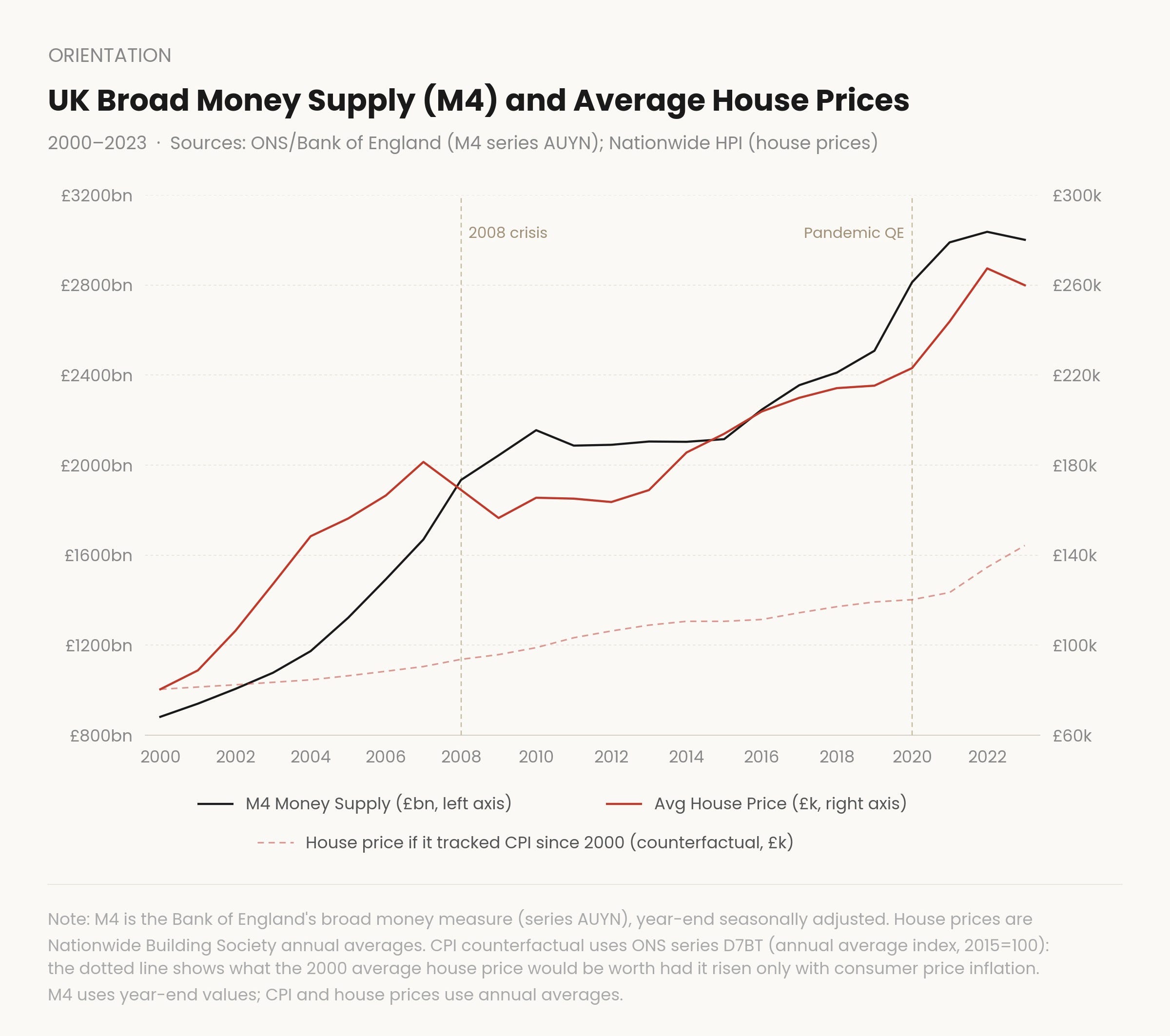
We don’t build enough housing in the UK. It’s a scarce asset, which is why, when the money supply expands, it shows up on Rightmove, and in how hard it is to get a foot on the ladder.
Bitcoin emerged as my answer to that.
Unlike the pound in your pocket, there will only ever be 21 million Bitcoin. I discovered it in late 2023. At the time, I saw it as a financial hedge — a scarcer asset repricing in a world of expanding money. Over the following two years, it moved sharply higher.
During this time, I lived on a ‘Bitcoin standard’. Each month as I was paid, I’d meet my proportion of the monthly budget, clear my credit card and convert the remainder of any savings into Bitcoin.
My bank account read £0 most days of the month.
It sounds crazy, operating like that. But it had the opposite effect: anchoring me.
Having a fixed point to organise my finances around, and in time, my life, brought a focus that I didn’t have before. Learning more about it opened me up. I started seeing things differently.
My girlfriend and I could pay more for our food shop, or to have the heating on. I thought about the predicament for people like Ubi, or Simon, working honestly and just as hard, for less. It made me feel resentful. Gutted. Knowing that money is created, benefiting those with assets, while widening the gap for those without that to fall back on.
I stopped viewing Bitcoin as a financial bet and started treating it as a principle to live by. For the first time, something to believe in.
This is all quite easy to say when you’ve got a decent job and the certainty of being paid at the end of the month. I resigned from that job in October 2025, and in the three months of my notice period, Bitcoin lost 20% of its value. A further 25% in the January and February that followed.
I’d built a buffer to start this next chapter — never enough to watch it happen without feeling it.
It’s why I’m writing this at a Bitcoin price of $67k, not $120k. Because I could be wrong. I don’t think I am, but there’s no falling back on a corporate job now. I’m onwards or bust.
It’s uncertain, like the world. I do, however, have conviction in something finally. And there’s a steadiness in that. I’m not back at university parroting the books I read or the ideas of philosophers I never met, or working a job that towards the end my heart was never in. I want to think aloud. Process things as much for myself as for anyone else.
I found belief in something most think is a speculation. It feels bigger than a financial position. Not just for me. For anyone whose money and value is being diluted.
It isn’t a one-way journey. I’m learning that it demands something back.
In return, it gave me the first thing I’ve genuinely had to live up to. And the courage to begin.