



Written by Lewis Thomas
One of life’s quieter comforts is walking into a familiar pub and being met without pause. No scan of the taps. Just a nod, a grin, and “the usual, right?”
Your face is recognised. There is a thread of continuity - a sense that something about you has been carried forward since your last visit. The same feeling surfaces when you meet an old friend after years apart and find the conversation resumes without effort. It is easy to pick up where you left off, not because everything is remembered, but because enough of you is.
The expectation of continuity no longer stops at people or places. It’s beginning to appear elsewhere. We notice the irritation when we’re made to start again: to restate context, re-explain aims, rebuild a trail we thought was already there. The friction is felt as inconvenience or wasted time, alongside a sense that something which could have been held, wasn’t.
This type of discomfort isn’t new. Long before modern technology, thinkers recognised that our understanding hinges on memory - on the ability to draw on past experience and carry it into the present. As John Locke argued centuries ago, what makes you you over time isn’t your body or your intelligence, but the string of memory linking past experience to the present. Without that, each moment would arrive as if for the first time, disconnected from what came before.
“as far as this consciousness can be extended backwards to any past action or thought, so far reaches the identity of that person; it is the same self now that it was then…” An Essay Concerning Human Understanding, Book II, Chapter XXVII
The change now is where that continuity is showing up - beyond the normal bounds of human relationships, in systems that carry it across time and space.
Artificial intelligence is rewriting memory in silicon. While many systems have been able to store information previously, AI takes this a step further, using memory actively to shape the present through what it retains. Past interactions with a user don’t just sit in a record; they can feed back into how the system responds, allowing understanding to accumulate rather than reset.
Until recently, interacting with most AI meant starting from near-zero each time. Every conversation was treated as a first encounter. Close the window, begin again. Whatever had just happened was gone. The system could generate remarkably fluent and in-depth responses, but it carried no sense of you across interactions. Context did not persist; each exchange stood alone.
That is beginning to evolve. Some systems can now carry elements of context forward - not comprehensively, not reliably, and not yet with much subtlety. However, even this partial continuity introduces something new. Interaction stops feeling like repeated querying and starts to feel like the resumption of something already in motion: fragmented, but ongoing.
A system that remembers you feels less like a tool and starts to function as relationship infrastructure, building understanding over time, rather than simply retrieving or storing facts.
Persistent memory is powerful because it changes the nature of the interaction.
Over time, it creates a continuity that goes beyond intelligence alone. Patterns accumulate. Context thickens. Connections can emerge. Sometimes this is deliberate and prompted, sometimes it’s without the user noticing them being made.
For me, this persistence has emerged in small but meaningful ways.
I was born with osteogenesis imperfecta - a genetic condition that affects bone strength, and shapes everyday decisions. It’s the kind of constraint that usually has to be carried internally, or explained repeatedly: when thinking about exercise, equipment, recovery, or diet.
As AI systems begin to retain context, even in a limited way, something subtle changes. I no longer have to restate or reframe the condition each time it’s relevant. It’s already there - held in the background - and can surface naturally when decisions are discussed. This helps with optimisation, but it also provides the relief of not having to explain yourself every time.
This kind of continuity improves individual exchanges. It also allows a system and its user to hold threads together over time. Through this broader context, choices can begin to make more sense. The result isn’t certainty or direction, but greater coherence.
Human memory, by contrast, has never worked this way.
Our remembering is partial and reconstructive. We piece together the past from small glimpses, shaped by what we already know and expect. Much of what we experience is forgotten, and even what remains is rarely an exact record of what happened.
This imperfection is not a flaw. It’s part of how memory works for humans. It’s adaptive, selective, and alive to the present rather than completely faithful to the past. We understand this intuitively, so it is not a surprise when we misremember or disagree about details.
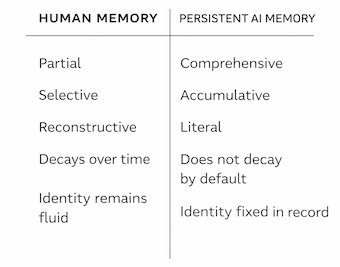
Memory’s closeness to identity is what makes it so intimate. Our past experiences shape how we respond, what we notice, and who we become. That intimacy is also why the loss of memory is so devastating. As the past disappears, so does a part of who we are.
Forgetting also serves an important function. By allowing details to fade, our minds make room for what matters, letting the past inform the present without overwhelming it.
Sometimes this can be deliberate rather than accidental. Forgiveness, for example, depends on the ability to loosen the grip of a memory and to allow what happened to recede, even if it is not fully erased. The same is true when we forgive ourselves.
We all carry experiences we would rather not relive in full: mistakes, losses, moments that last longer than they should. If every memory remained vivid and permanent, there would be little space for healing, peace, or reinvention. Forgetting is what allows life to continue without being endlessly replayed. It makes life liveable. We forget because we must. For the sake of our mental and physical health, and to allow identity to remain fluid, rather than fixed.
A system designed and incentivised to retain information indefinitely does not forget in the way humans do. It does not prioritise, reinterpret, or wane with time. Memory, in this case, is not shaped by limitation.
The development of this kind of memory tips the balance between human and AI. It alters the relationship, shifting trust from something felt to something structural.
In human relationships, trust is provisional and internal. It’s built through shared experience, adjusted over time, and withdrawn when something no longer feels right. You trust a friend, but can still hesitate. You trust a professional, but may seek a second opinion. Trust lives in judgement.
With persistent AI memory, that judgement changes shape. The system already holds your history. You may not be able to fully verify what it remembers, yet its memory shapes the interaction before you act. Participation assumes trust, because continuity depends on it. Understanding accumulates within a memory system unconstrained by natural limits. The user, in turn, becomes reliant on how that memory is recalled, interpreted, and brought into the present.
Reliance can also emerge more explicitly.
As users increasingly rely on AI systems to act as memory, the incentive to remember for themselves weakens. A similar process appears to have played out with the proliferation of mobile-phone GPS. These tools did not make people worse at navigating overnight, but they slowly changed how often people tried. Routes once learned became routes followed. Orientation shifted from internal knowledge to external instruction. Memory, outsourced, slipped out of use.
Persistent AI memory introduces a similar dynamic. As the system gathers context, history, and preference, the user is freed from holding those threads alone. The question is not whether this is useful - it clearly is - but how much remembering we are willing to give up in exchange.
As the cost of data storage has collapsed, remembering has become the default. It is now often cheaper and easier to keep information than to decide what to discard.
In that environment, memory stops being a choice and becomes a cumulative process. Data is kept not because it is immediately useful, but because it might be. What can be remembered, increasingly is.
Systems not bound by human limits can drift toward unified memory. A single, continuous record can span decisions, preferences, conversations, and contexts across a person’s life. The more complete that memory becomes, the more useful the system appears - able to recognise and anticipate needs, and personalise responses with increasing precision.
Continuity also carries economic weight. A system that remembers more feels harder to leave, not through coercion, but because starting elsewhere means starting again.
Unified memory can retain and recall even minute details, and does not forget in the way people do. It does not soften experience with time or allow earlier versions of the self to loosen their hold. Where human memory is selective and fleeting, unified memory remains intact.
While bringing undeniable power and potential, it is unclear whether a form of remembering optimised for these systems can peacefully coexist with life that depends on letting things go.
There are already situations where we entrust our most intimate memories to others.
Doctors, therapists, and lawyers routinely hold our personal histories, vulnerabilities, and even confessions - often formally recorded, but deliberately contained. Those memories are bounded by domain, shaped by professional duty, and protected by norms that acknowledge their power.
Something similar is beginning to take shape with AI systems.
Through repeated interaction, they can assemble a working sense of who someone is over time. That picture may become more encompassing than the one held by any single professional.
AI systems may come to hold information as intimate as that shared with a doctor or therapist, but they are not bound by the same ethical or institutional duties. These conversations lack those kinds of professional privilege and are not governed by norms that define responsibility, confidentiality, or restraint. This is both a privacy concern and an ethical gap: memory entrusted, without a corresponding obligation to protect it.
This gap is not theoretical. Even those building these systems acknowledge it.
Speaking on Theo Von’s This Past Weekend podcast, Sam Altman put it plainly:
“People talk about the most personal [shit] in their lives to ChatGPT. People use it as a therapist, a life coach. Right now, if you talk to a therapist, lawyer or doctor about those problems, there’s legal privilege for it, there’s doctor-patient confidentiality, there’s legal confidentiality. We haven’t figured that out yet for when you talk to ChatGPT. If you go talk to ChatGPT about your sensitive stuff and there’s a lawsuit, we could be required to produce that. I think that’s screwed up.”
Historically, sharing memories has been a privilege based on friendship or duty. With AI, memory is arriving first - ahead of obligation, protection, or defined responsibility. This sequence matters.
We are now entering a future where the past is more concrete.
Memory may no longer fade by default. It can be retained, recalled, and reintroduced with accuracy - offering coherence, clarity, and a continuity that humans have never been able to sustain alone. But this clarity comes without the limits that once shaped it. Forgetting is no longer guaranteed. Distance from the past is no longer automatic. And the process through which we move on from who we were - and discover who we are becoming - is less certain.
Being remembered is a relief, until remembering stops knowing when to let go.
If you’d like to follow the thinking as it develops between essays, I occasionally write in public on X via @OrientationFrom and Nostr via @Orientation.